
Case Study
How Mast Overhead
Cut Cost Per Lead 80.3%
in 5 Months
Google + Meta Ads - Jan. - May 2026
About the Client
Mast Overhead Doors has been serving homeowners and businesses across southern Iowa and northern Missouri for over 20 years. Operating out of two locations, Bloomfield and Albia, Iowa, they handle everything from emergency spring repairs and opener replacements to new door installations across multiple counties in both states. Residential and commercial, two decades of reputation built entirely on referrals and repeat customers.
Before Fencepost, they weren't running paid ads at all. Twenty years of business built entirely on referrals and word of mouth, which works, until it doesn't. When they decided to finally turn on a paid channel, they wanted to do it right from the start.
The Challenge
Mast Overhead had never run paid ads before. All their work had come through referrals, repeat customers, and community reputation. That model works. But referrals are unpredictable. You can't turn them up when the schedule gets slow.
The challenge wasn't fixing a broken ad account. It was building one from scratch and doing it in a way that produced real jobs, not just activity.
That meant solving for everything at once:
- No baseline to work from. No prior campaign data, no keyword history, no call tracking, starting completely cold.
- A market with real search demand, but no paid presence. Homeowners in southern Iowa searching for garage door repair were finding competitors. Mast Overhead wasn't showing up at all.
- No way to attribute inbound calls. Without tracking, there'd be no way to know which keywords were producing jobs and which were wasting budget.
- A gap in Facebook and Instagram. Not every homeowner searches Google immediately; in-market homeowners were reachable on social, but Mast Overhead had no presence there either.

Objectives
At Kickoff We Set Four Goals:
-
1
Reduce cost per lead from $382.92 to under $150 within 90 days
-
2
Grow monthly lead volume from 7 to 40+ within the same window
-
3
Set up full call tracking so every inbound call is attributed to the right keyword
-
4
Launch Meta Ads as a second channel to capture demand beyond Google search
OurApproach
-
Rebuilt the Google Ads account from scratch.
Rather than patch the existing campaigns, we started clean. New campaign structure, new keyword list, focused exclusively on high-intent, job-specific searches in the local market.
-
Added 40+ negative keywords in the first 30 days.
DIY searches, commercial queries, parts requests, and out-of-area searches are all blocked. Every dollar wasted on irrelevant searches went back to searches that convert.
-
Restructured ad groups by job type.
Emergency repair searches got their own ads and landing page angle. Spring replacements got theirs. New door installs got theirs. When the ad matches what someone is actually searching for, close rates follow.
-
Set up WhatConverts for full call tracking.
Every inbound call is tied back to the keyword and campaign that generated it. No more guessing. Every optimization decision from Month 2 forward was based on real data.
-
Launched Meta Ads in Month 2.
Facebook and Instagram let us get in front of homeowners who need a garage door but haven't searched yet (a different audience, a different message, and a different cost structure). It added a second lead stream without cutting into Google's performance.
Tools & Methodologies.

Google Ads
For paid search campaigns, conversions, and customer reach.
Meta Ads
Manager
For targeted advertising across Facebook and Instagram.

WhatConverts
Call tracking
For connecting calls and leads to their marketing sources.

GA4
For website traffic, user behavior, and conversion insights.
Fencepost
Live reporting
For real-time access to campaign results and performance.
Phased stages
Implementation Timeline
To ensure steady growth and measurable results, the campaign was executed in phased stages over five months.
-
1
January, Build
Full account audit. Rebuilt campaign structure from the ground up. Keyword research targeting local, high-intent service searches. WhatConverts installed. The first month was an intentional slow burn; the goal was a clean foundation, not volume.
Key stat:
→ 7 leads|$382.92 CPL
-
2
February, Launch
Restructured Google campaigns go live. Meta Ads launch with a separate budget. Lead volume jumps from 7 to 29. Cost per lead drops from $382.92 to $139.21. The foundation was working.
Key stat:
→ 29 leads|$139.21 CPL
-
3
March, Optimize
Negative keyword list expanded based on search term data. Ad copy tested against call-through rates. Facebook creative refined. 43 leads at $92.48 CPL. The drop is accelerating.
Key stat:
→ 43 leads|$92.48 CPL
-
4
April, Compound
The account has 90 days of clean data. Optimization decisions are sharper. 49 leads at $82.21 CPL. Close rate hits 60.7%, more than half of every lead becomes a booked job.
Key stat:
→ 49 leads|$82.21 CPL • 60.7% close rate
-
5
May, Scale
Lead volume hits 60. CPL holds at $75.56. The account is running efficiently, and the pipeline is full.
Key stat:
→ 60 leads|$75.56 CPL
Results
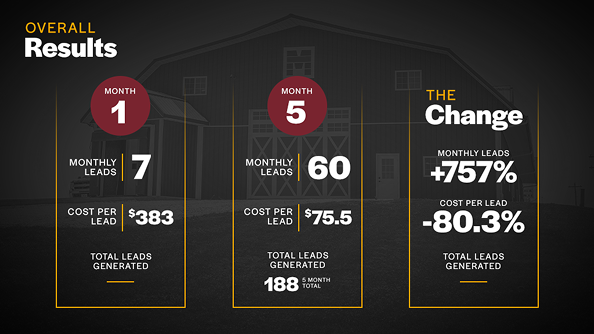
Cost per lead dropped from $382.92 to $75.56, an 80.3% reduction in 5 months.
By month four, the account hit a 60.7% close rate. More than half of every lead became a booked job. Mast Overhead had never run a paid ad before January. Five months later, the phone rings 60 times a month from people ready to book.
See what this looks like for your market
| Metric | January (Month 1) | May (Month 5) | Change |
|---|---|---|---|
| Monthly leads | 7 | 60 | +757% |
| Cost per lead | $382.92 | $75.56 | -80.3% |
| Total leads generated: 188 across the five-month period. | |||
Source: Google Ads, Meta Ads Manager, and WhatConverts call tracking, January to May 2026.
KeyTakeaways
-
The first month isn't your results, it's your foundation
January produced 7 leads at $382/each. That wasn't failure. That was a clean build. Agencies that promise immediate results are skipping the work that makes results last.
-
Negative keywords are the fastest ROI in Google Ads
Cutting wasted spend on irrelevant searches doesn't cost anything. It just stops the bleeding. CPL dropped $243 in 60 days largely because we stopped paying for searches that were never going to book.
-
If you can't attribute the call, you can't optimize the campaign
Call tracking isn't optional. Every decision we made from Month 2 forward was based on which keywords were producing calls, not impressions, not clicks. Calls.
-
Google and Facebook together outperform either one alone
Some homeowners search when the spring breaks. Others are on Facebook on a Tuesday and suddenly remember the door has been slow for two months. Both are in-market. One channel leaves the other half uncaptured.
-
Results compound. They don't arrive.
The work done in January is still paying off in May. CPL doesn't drop 80% overnight, it drops month by month as the account gets smarter. The businesses that quit at Month 2 never see Month 4.
Every Month You're Not Running Ads...
Someone searching for your service in your market is calling your competitor.
Mast Overhead didn't know if paid ads would work in their market. Neither do most of our clients, until month two. If you're a home service business and you want to know what this looks like in your city, that's exactly what the discovery call is for.
No commitment. 30-minute call.